
If another UK business pays your inoice late, UK law gives you the right to charge statutory interest. The rate is 11.75% a year (until 31 December 2026). You can also chage fixed compensation of £40-£100, plus reasonable recovery costs. Your rights come from the Late Payment of Commercial Debts (Interest) Act 1998.
Table of Contents
No Cost. No Obligation.
100% Confidential.
A Brief Overview of UK Law on Late Payments
The law that provides your rights is the Late Payment of Commercial Debts (Interest) Act 1998. There have been two significant updates since the law was introduced:
- The 2002 update implemented the EU Directive 2000/35/EC of the European Parliament and of the Council of 29th June 2000. This is designed to combat late payment in commercial transactions.
- The 2013 regulations added the right to claim “reasonable costs in excess of the fixed sum to which they are entitled“.
The Act covers late payments from one business to another, and also covers public authorities. It applies to goods and services.
This particular law does not govern consumer debts, where an individual owes money to a business.
Does Brexit Impact the UK Law on Late Payments?
An EU directive around late payments was included in the 2013 regulations. Even though the UK has left the UK, that part of EU legislation is still in force, meaning Brexit did not change it.
When Does an Unpaid Invoice Become a Late Payment in Law?
A payment becomes late according to the following structure:
- Any contract with a public authority must be paid within 30 days.
- If you have a contract with another business and you’ve specified a payment date, the invoice is considered to be late on the day after the due date in the contract has passed
- If you do not have a contract or a payment date, the default is 30 days after the customer receiving the invoice, or you delivering the goods (whichever is later)
You are free to agree terms up to 60 days if you wish, but longer terms may not be enforceable. It depends if they are deemed to be fair or not, and whether the agreement was specific.
How Much Interest Can You Charge?
The statutory interest rate you are allowed to charge on your overdue invoices is often described as being 8% above the Bank of England base rate – and this is true, as a rule of thumb.
However, it is worth noting that the ‘reference rate’ does not change in real time when a Bank of England Monetary Policy Committee decision is announced – instead, it is set twice a year, in January and July.
The rate set on January 1st is based on the Bank of England base rate for the preceding day, December 31st, and remains in place until June 30th of the same year; the July 1st rate is based on the June 30th base rate, and remains until December 31st of that year.
For 2026, the base rate on both dates was 3.75%. So the statutory rate for 2026 is 11.75%.
The table below shows the breakdown of fixed fees chargeable on different sums of money owed.
Interest is calculated daily. You can use our free late payment calculator to work out exactly what you’re owed.
How Much Are Fixed Compensation and Recovery Costs?
As soon as your invoice becomes late, you are entitled to claim a fixed fee plus “reasonable” compensation on top of the invoice and the interest. There is no set “reasonable” amount.
In the table below, the ‘Recovery Costs’ column is a very loose estimate based on our approximate charges.
| Amount Owed | Fixed Fee | Recovery Costs (est) |
| £0.01 – £999.99 | £40.00 | £110 |
| £1,000.00 – £9,999.99 | £70.00 | £80 – £1,429.99 |
| £10,000 and above | £100.00 | £1,400.00 and above |
We charge a fixed fee of £150.00 for claims for amounts of less than £1,000 – which is why the claimable recovery costs are a single stated amount for smaller amounts.
Above the £1,000 threshold, the costs will be a percentage of the total amount owed – and on large amounts that are significantly overdue, the combination of this percentage and the statutory interest charged can lead to extremely substantial amounts recovered under the new legislation.
What Changes are Being Considered to Late Payment Law in 2027?
A new law is going through Parliament now. The Commercial Payments Bill, announced in May 2026 as the biggest crackdown on late payment in over 25 years, would:
- Cap payment terms at 60 days when a larger business buys from a smaller one
- Make statutory interest mandatory so it cannot be contracted away
- Allow customers 30 days to raise an invoice dispute
- Give the Small Business Commissioner the power to investigate and fine persistent late payers.
As of August 2026, the Bill is at Report stage in the House of Lords, and the new rules are not expected to take effect before 2027.
It follows a run of smaller changes: the Fair Payment Code replaced the Prompt Payment Code in December 2024, grading signatories gold, silver or bronze on how fast they actually pay.
Large companies now have to report their payment performance in more detail, including the value of invoices paid late.
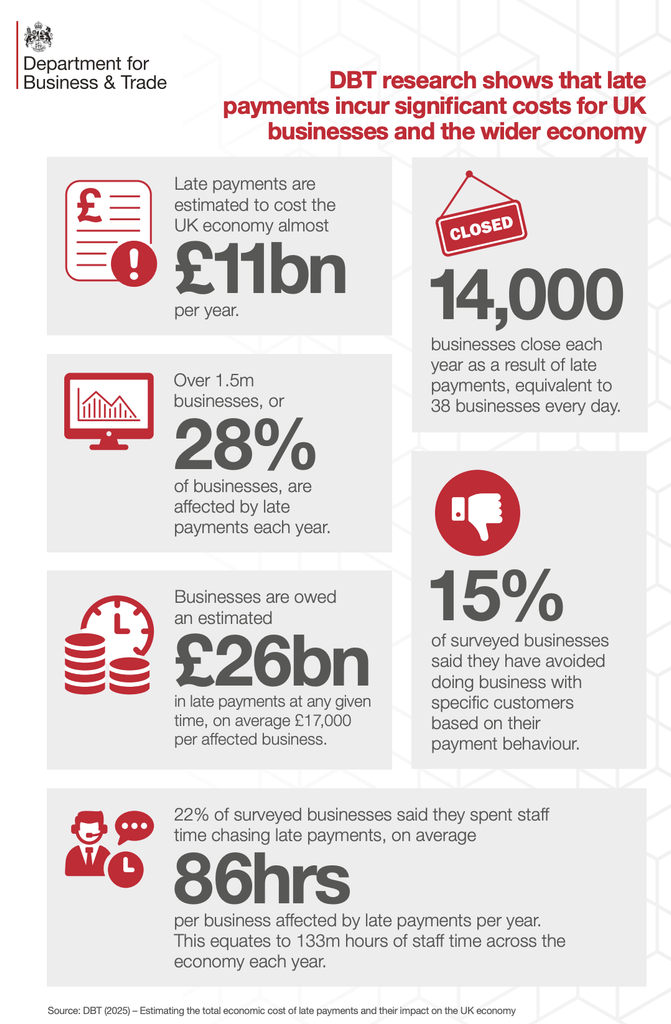
The reason for the pressure is the scale of the problem. Government-commissioned research published in 2025 put the cost of late payment to the UK economy at nearly £11 billion a year, with 38 businesses closing every day because of it.
Questions About Late Payments in UK Law
Can our contract exclude statutory interest?
Generally, no, unless you include an alternative remedy. Even then, you cannot remove your own rights.
Does it apply if the contract says nothing about late payment?
Yes. The Act implies the term into the contract automatically.
How far back can we claim?
Up to six years. You can also claim the interest and compensation after the customer has paid the original invoice.
Is the fixed sum per invoice or per customer?
It’s difficult to say whether the fixed sum is per invoice or per customer as this can depend on the specifics of the case. Technically, it would be per invoice, but this can change as the case progresses.
What if the invoice is disputed?
Interest runs from when the debt was due. A genuine dispute over the goods or service is a different question from slow payment, and disputed invoices are worth resolving quickly for that reason.
Should you actually charge it?
The right is automatic; using it is a commercial choice. Plenty of suppliers waive interest on a good customer’s first slip and invoke it for repeat offenders. A payment reminder that mentions statutory interest often does the job on its own.
If reminders and interest haven’t moved the debtor, that is the point where recovery action makes sense, and because the Act makes recovery costs claimable from the debtor, taking action does not have to mean writing off more money. Contact us for a free claim review.
