
How do you deal with a client that always pays late?
Some clients are disorganised, but some actually use late payments to manage their own cashflow, which can put you at a disadvantage.
You can improve your chances of getting paid if you subtly change your credit control processes, and we’ve put together some advice that actually works.
Table of Contents
No Cost. No Obligation.
100% Confidential.
1. Learn to Handle Late Payment Excuses
Dealing with late-paying clients is easier if you’re prepared to deal with the excuses customers give for paying late.
When you have worked in the debt collection industry for as long as we have, you can be sure we have heard some imaginative excuses, along with some that are so old they were probably being used in Roman times.
Here’s a list of excuses for late payment along with our expert advice on how to handle the situation:
| Late Payment Excuse | Examples | How to Deal With It |
|---|---|---|
| System errors | Your invoice never arrived. Our accounts system is down. | Always call the client to confirm invoices were received, and do this before the deadline so they have less reason to delay. Check your accounts software email reports to see if your invoice was delivered. |
| Supply chain problems | We can’t pay you until our client pays us. We had to pay someone else first. | Take a firm line with your client. Ensure they are aware of their failure to make payment as agreed and be prepared to invoke your rights to additional late payment penalties under UK legislation. In the future, use staged payments. |
| Disputes | The invoice is wrong. We’re unhappy with the goods or services. | Contact clients after the invoice is sent but before it’s due. Confirm there are no issues well before payment is due. |
| Company crisis | Our accounts person is on holiday. We had a fire in the office. | Ask if anyone else at the company can sign off or otherwise authorise your payment, even if it is just a one-off. At the very least, ask for an expected return date so you can follow up on your unpaid invoice in a timely manner. |
| Payment problems | We can’t use the payment method specified. | Ensure you have agreed on payment terms, especially when dealing with international clients. For late payments, consider allowing online payments, or ask the customer which services they’ve used and see if they would be acceptable to you temporarily. |
| Personal emergencies | Someone passed away or is seriously ill. | Be sensitive and diplomatic. Try to ascertain the facts. In the event of a death or serious illness, be humane and consider that this may have a devastating impact on the ability of a small business to stay afloat. Be mindful of this in any pursuit of payment and consider hiring a credit control expert to support you. |
There are situations, like personal emergencies, where chasing a debt aggressively is not a good idea. However, if you see the same excuses month in and month out, you should be wary that this client is in financial difficulty, particularly if their excuses are increasingly creative.
For a one-off or a serious event, it’s best to be understanding until you establish the facts. It may be sensible to hire credit control consultants who can advise you on how to handle the issue (or deal with it for you).
No Cost. No Obligation.
100% Confidential.
2. Reward Prompt Payments
Clients who regularly pay late may have a culture of pushing invoices over their deadlines. If you work with medium and large businesses, you may battle this month in, month out.
Sometimes it feels like the company is badly organized or chaotic. But persistent late payment can actually be an intentional policy to keep your cash in their bank account for as long as possible.
Offering a small discount might encourage your late payer to prioritise your invoices and avoid pushing them later and later each month. So, if your margins allow, we suggest you offer a 5% credit on the client’s next invoice if they pay the current month’s invoice on time. That can be an effective way to correct the situation in the long term.
If you don’t want to offer your persistent late payer a discount, you could offer to make a donation to charity in return for every invoice paid on or before the due date.
3. Accept Part Payments or Alternative Payment Methods
When dealing with late-paying clients, it’s a good idea to allow small, incremental payments if it moves you towards being paid in full.
This is especially true when dealing with international clients who may not be able to use some of the services your UK clients pay with.
Wise has an excellent guide to international payment methods that may be helpful.
You may also need to be prepared to meet the client halfway, if your situation allows. For example, you could look at accepting alternative payment methods temporarily or as a variation to your original terms.
For example, temporarily accepting debit card payments over the phone might be a good idea when dealing with a late-paying client, since you may be able to get paid immediately when you call them.
Only vary your terms if it moves you towards being paid without large fees being incurred, and make sure you let them know it’s a one-off.
4. Check the Late Paying Client’s Credit Report
If a client always pays late, checking their credit report is a smart move, especially if unpaid invoices are mounting up.
- Our guide to reading a company credit report can help you to spot red flags and interpret the information.
- We work with Experian, the market leaders in credit scoring, to offer 50% off credit reports.
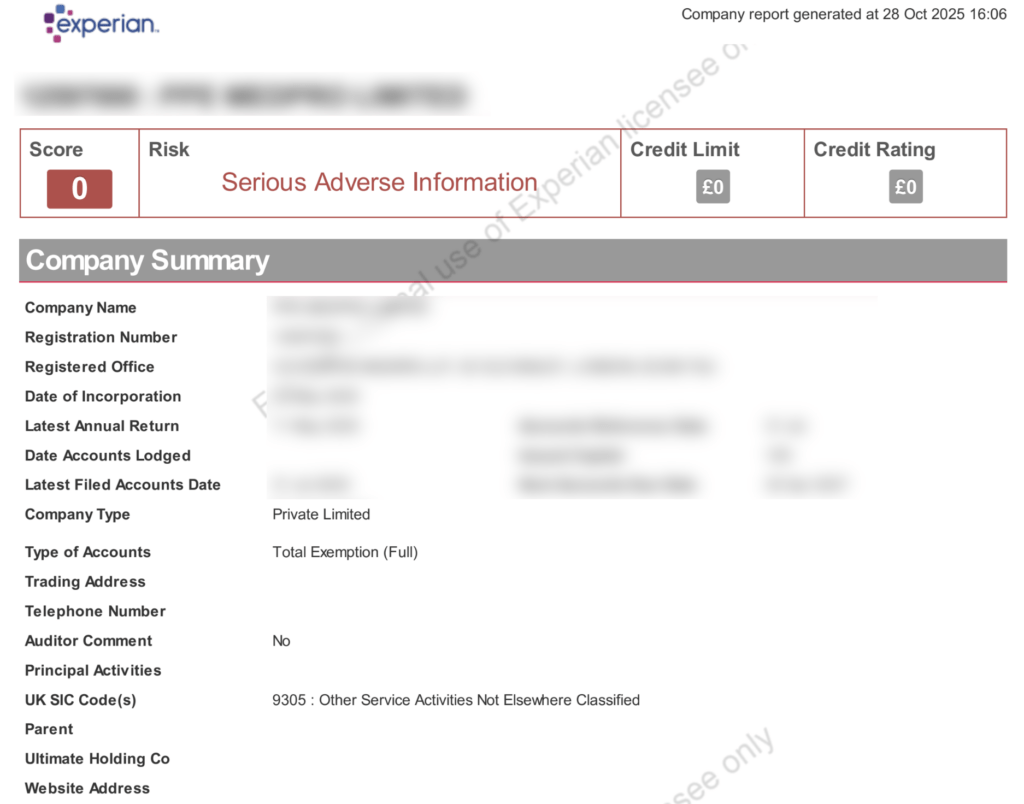
When used correctly, business credit reports can reveal signs of ongoing financial difficulties, like:
- Credit scores dropping
- Credit risk assessment changing
- Recommended credit limits reducing
- Payment history issues
- County Court Judgments (CCJs)
If you see problems on a credit report, it’s a sign that your client may have cash flow issues and may not be in the best position to pay you on time. That can be useful information if you’re on the fence about whether to continue to work with them.
It can also help you to decide whether debt recovery is necessary sooner rather than later.
5. Check Clarity of Contracts
Review your payment terms and contract to make sure everything is written down and there’s no wiggle room for late payments to be justified.
Some clients take advantage of unclear documentation.
And to be clear, all businesses are free to set their own payment terms. But you’ll need to be pragmatic to have a realistic chance of compliance. A term of 30 days is generally accepted as the norm, but you can vary this if your client agrees.
If you aren’t yet giving out a contract or terms and conditions, start now so you’re not dealing with late-paying clients quite so often in the future.
- Set a payment deadline – 30 days or whatever is mutually acceptable
- Ask for the details for the finance department so you can send invoices to the right person
- Get a signature on your agreement so that everyone is committed to the terms you set.
If your client is trying to change payment terms after you’ve made an agreement, check out our guide to dealing with clients who dictate payment terms.
6. Send Reminders When Invoices Are Due
Most accounting platforms allow you to set up automatic email reminders. Use these to remind your late-paying client that an invoice is due for payment.
You don’t need to write anything complicated in your payment reminder emails. A simple text email with the invoice attached will work.

On the day after the due date, send another reminder so they know you expect the invoice to be settled promptly.

From experience, we recommend that you use these emails as helpful nudges. But always follow up email reminders with a telephone call.
If you don’t feel comfortable pushing for payment over the phone, hire a virtual credit controller to do this for you.
7. Be Receptive to Feedback
Sometimes, a persistent late payer may be unhappy with the work you’ve done, and it’s best to be honest with yourself if this happens. They may be right. Perhaps something is missing or could have been done better.
Accepting criticism can be difficult, but it’s important to take feedback on board and consider whether you need to redo some work or improve a process.
This doesn’t excuse the fact that some clients will wait until the last minute to complain, just to delay making a payment. If this keeps happening, there may be a genuine problem, or it may be a sign of deeper issues in their company.
No Cost. No Obligation.
100% Confidential.
Either way, the best way to avoid late payment is to deal with all feedback quickly and proactively. If you resist, the client has an excuse to delay further.
To avoid situations where clients don’t pay because they’re unhappy, make sure your contract, terms, or order forms outline exactly what you’re expected to deliver so you can avoid miscommunication and complaints.
8. Contact Multiple People in the Accounts Department
Large businesses will have multiple people dealing with payments, so it makes sense to keep track of who you contact.
If your client pays late because someone in accounts is out of the office, that might make sense as a one-off. But if it keeps happening, it might be a sign that someone is intentionally delaying the payment. Having multiple contacts can help you to chase the payment through someone else.
This is another good reason to phone to ask about payment. It’s hard for someone to hide when they already answered your call.
Either way, wext time the person with the purse strings is out of the office, call and find out who can authorise payment in their absence. Get their name and email address in case you need to send out a late payment letter.
9. Ditch the Client
For most businesses, clients are expensive to onboard and difficult to drop.
But dealing with late-paying clients can impact business ROI if your client consistently pays late.
The smaller your business is, the more a client may think they can push you around. That’s why we are perfectly comfortable recommending that you fire any client who is not willing to pay you what you’re owed.
No Cost. No Obligation.
100% Confidential.
Constantly being paid late can have a real-world impact on you, your business, and your family. The worry can eat into your profits and cause issues with getting other work done.
There may come a point where the return is not great enough to warrant the stress, and you would be better off letting one of your competitors deal with the late-paying client instead.
10. Be Confident in Chasing Money You’re Owed
To recover the money you’re owed, you need to be assertive and confident that you are entitled to be paid for the work done or goods supplied.
So when faced with late payment excuses, remember that:
- Your company is owed the money
- You have every right to seek payment
- There is a deadline by which you are entitled to be paid
- You have a right to pursue payment if you don’t receive it
These points are always true, even when the explanations provided by the client appear to be genuine, or when there are special circumstances.
Is It Time to Find a Debt Recovery Service?
Once you’ve exhausted all of your options, we’d be happy to support you with our professional debt recovery services. We can also advise you on your right to charge late fees, interest, and costs.
Contact us today for a free review of your claim.
